
Commercial Bread Dough Mixer For Professional Bakeries
Complete Guide to Commercial Bread Dough Mixers
Transform Your Bakery Operations with Professional-Grade Mixing Equipment
Why Does Your Bakery Need the Right Commercial Dough Mixer?
In the competitive world of professional baking, the quality of your bread starts with one critical decision: choosing the right commercial bread dough mixer. Whether you’re running a small artisan bakery or managing a large-scale production facility, your mixing equipment directly impacts product consistency, operational efficiency, and ultimately, your bottom line.
A professional bakery dough mixer is not just another piece of equipment—it’s the foundation of your bread-making process. The right machine ensures uniform dough texture, reduces labor costs, and enables you to scale production while maintaining the artisanal quality your customers expect.
This comprehensive guide will walk you through everything you need to know about selecting, operating, and maximizing the value of commercial dough mixing equipment for your specific business needs.
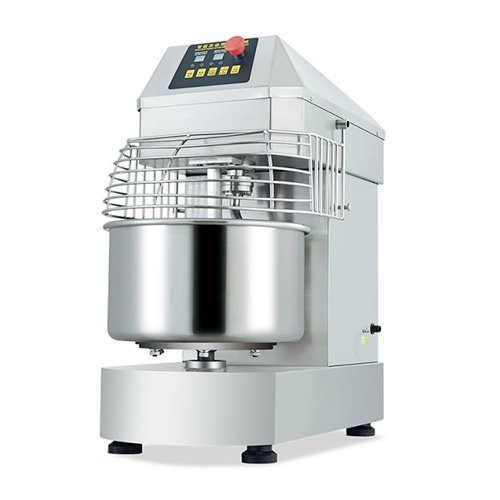
Professional spiral dough mixer designed for commercial bakery operations
What Is a Commercial Bread Dough Mixer?
A commercial bread dough mixer is a specialized piece of bakery equipment designed to combine and knead ingredients efficiently and consistently at a professional scale. Unlike domestic mixers, these industrial-grade machines are engineered to handle substantial volumes of dough while maintaining precise control over mixing speed, duration, and technique.
Key Components of Professional Dough Mixers:
- Heavy-Duty Motor System: Provides consistent power for thorough mixing regardless of dough density
- Stainless Steel Mixing Bowl: Ensures hygiene standards and durability for daily commercial use
- Multiple Speed Settings: Allows precise control for different dough types and recipes
- Professional Mixing Attachments: Includes specialized hooks and paddles for various bread types
- Safety Features: Incorporates protective guards and emergency stop mechanisms
- Robust Construction: Built to withstand continuous operation in demanding commercial environments
These machines are available in various capacity ranges—from compact models suitable for artisan bakeries to large-scale units designed for industrial bread production facilities. The capacity you choose should align with your daily production volume and growth projections.
Which Business Scenarios Benefit Most from Commercial Dough Mixers?
Professional bakery equipment serves diverse commercial environments, each with unique operational requirements. Understanding where these machines deliver maximum value helps you make an informed investment decision.
|
🥖
Artisan BakeriesSmall to medium-capacity mixers enable craft bakers to maintain handmade quality while increasing production efficiency and consistency across batches. |
🏪
Retail Bakery ChainsMulti-location operations require standardized equipment that ensures product consistency across all outlets while supporting centralized or distributed production models. |
🏨
Hotels & RestaurantsHospitality establishments benefit from versatile mixers that handle fresh bread production alongside other dough-based menu items for in-house dining services. |
|
🏭
Industrial BakeriesLarge-scale production facilities require high-capacity equipment capable of continuous operation, supporting wholesale distribution and mass production requirements. |
🍕
Pizza RestaurantsPizzerias need specialized mixing capabilities for dough that requires specific texture and elasticity, with equipment that supports high-volume daily preparation. |
🎓
Culinary SchoolsEducational institutions require reliable, user-friendly equipment that allows students to learn professional techniques while accommodating varied training scenarios. |
What Benefits Can Professional Dough Mixers Bring to Your Business?
Investing in quality commercial bakery equipment delivers tangible operational advantages that directly impact your profitability and competitive positioning. Here’s how professional mixing equipment transforms your bakery operations:
|
⚡
Enhanced Production EfficiencyAutomated mixing processes significantly reduce manual labor requirements while increasing throughput. Professional equipment handles larger batches in optimal timeframes, allowing your team to focus on value-added activities like product development and quality control. |
🎯
Consistent Product QualityPrecision-engineered mixing mechanisms ensure uniform dough development across every batch. This consistency eliminates quality variations, reduces waste from failed batches, and builds customer trust through reliable product standards. |
|
💰
Reduced Labor CostsMechanized mixing dramatically decreases the physical demands on staff and reduces the number of personnel required for dough preparation. This optimization allows you to reallocate labor resources to customer-facing roles or specialized production tasks. |
📈
Scalability for GrowthProfessional-grade mixers provide the capacity foundation needed to expand operations without equipment bottlenecks. As demand increases, your mixing infrastructure can accommodate higher volumes without compromising quality or requiring immediate replacement. |
|
🛡️
Improved Food SafetyStainless steel construction and enclosed mixing chambers minimize contamination risks compared to manual handling. Professional equipment meets stringent hygiene standards and simplifies sanitation procedures, supporting compliance with food safety regulations. |
🔧
Versatile Recipe CapabilitiesMultiple speed settings and interchangeable attachments enable you to work with diverse dough types—from delicate pastries to dense whole grain breads. This versatility supports menu diversification without additional equipment investments. |
Long-Term Business Impact:
Lower ingredient waste through precise mixing
Reduced energy consumption with efficient motors
Enhanced workplace safety for staff
Professional image for your bakery brand
How to Choose the Right Commercial Dough Mixer for Your Bakery
Selecting the optimal bread making machine requires careful evaluation of multiple factors. This systematic approach ensures your investment aligns perfectly with your operational requirements and growth trajectory.
1. Determine Your Capacity Requirements
Capacity selection is the most critical decision factor. Analyze your current production volume and projected growth to identify the appropriate size range:
📦 Compact Range
Ideal for: Startup bakeries, artisan bread shops, cafés with limited production needs, specialty bakeries focusing on small-batch products. These units fit in constrained kitchen spaces while delivering professional results.
📦 Medium Range
Ideal for: Established bakeries with steady customer flow, restaurant operations with significant bread service, growing businesses transitioning from small-scale production. Offers excellent balance between capacity and footprint.
📦 Industrial Range
Ideal for: High-volume production facilities, wholesale bakeries, multi-location operations with centralized production, commercial operations serving institutional clients. Designed for continuous daily operation.
2. Evaluate Construction Quality and Durability
Professional equipment represents a significant investment. Prioritize these quality indicators:
- Stainless Steel Components: Ensures corrosion resistance and meets food safety standards
- Heavy-Duty Motor: Look for robust motor systems designed for continuous commercial use
- Reinforced Frame: Stable construction that minimizes vibration during operation
- Quality Gearing System: Reliable transmission mechanisms that withstand daily stress
- Professional-Grade Attachments: Durable mixing hooks and paddles that maintain shape over time
3. Consider Operational Features
Modern commercial mixers offer various features that enhance usability and efficiency:
⚙️ Variable Speed Control
Multiple speed settings accommodate different dough types and mixing stages
⏱️ Timer Functions
Programmable timing ensures consistent mixing duration across batches
🔒 Safety Mechanisms
Bowl guards and emergency stops protect operators during use
🧹 Easy Cleaning Design
Removable bowls and accessible components simplify sanitation procedures
4. Assess Space and Installation Requirements
Before finalizing your purchase, carefully evaluate:
- Available Floor Space: Measure your production area and account for operational clearance
- Electrical Requirements: Verify your facility can support the mixer’s power specifications
- Workflow Integration: Position equipment to optimize production flow and minimize movement
- Ventilation Needs: Ensure adequate air circulation around the equipment
- Accessibility: Allow sufficient space for maintenance and cleaning activities
5. Review Warranty and Support Services
Reliable after-sales support protects your investment and minimizes downtime:
✓ Comprehensive Warranty Coverage: Look for manufacturers offering substantial warranty periods on major components
✓ Technical Support Availability: Ensure access to knowledgeable support staff for troubleshooting
✓ Spare Parts Accessibility: Confirm replacement parts are readily available when needed
✓ Maintenance Guidance: Request detailed maintenance schedules and procedures
✓ Training Resources: Ask about operator training materials or sessions
Quick Decision Framework:
When comparing multiple options, use this prioritization approach:
- Capacity Match: Does it meet your current and near-future volume needs?
- Build Quality: Will it withstand your intended usage intensity?
- Feature Alignment: Does it include the operational capabilities you require?
- Total Cost of Ownership: Consider purchase price plus maintenance and energy costs
- Supplier Reputation: Research the manufacturer’s track record and customer feedback
Discover Professional-Grade Dough Mixing Solutions
Whether you’re launching a new bakery or upgrading existing equipment, choosing the right commercial dough mixer is crucial for your success. Our comprehensive range of professional mixing equipment is designed to meet diverse operational needs—from compact artisan solutions to high-capacity industrial systems.
Why Partner With Us?
✓ Extensive selection of capacity options to match your production scale
✓ High-quality construction meeting professional bakery standards
✓ Expert guidance to help you select the optimal equipment
✓ Comprehensive support throughout your equipment lifecycle
Our team is ready to answer your questions and help you find the perfect mixing solution for your bakery.
