
How to Choose an Industrial Spiral Mixer for High Volume Dough Production
Heavy-Duty Industrial Dough Mixer Guide: Scaling Production in Central Kitchens and Bakery Factories
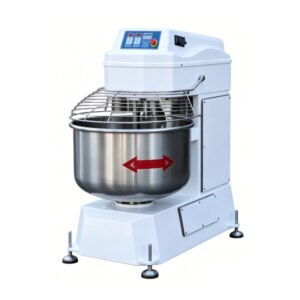
When food production scales from a single kitchen to an industrial operation, standard commercial equipment is often insufficient. Large-scale bakeries, central production facilities, and industrial food plants require machinery that can withstand continuous, multi-shift operations with minimal mechanical fatigue. For these high-volume environments, a heavy-duty industrial dough mixer is a key component of the production line.
Processing large batches of stiff dough—such as those required for bagels, artisan breads, and bulk pizza crusts—demands high torque, robust structural reinforcement, and efficient motor cooling. This guide focuses on our high-capacity heavy duty dough mixer series, engineered to handle up to 150 kg of dry flour per batch while maintaining high consistency and structural integrity.
Operational Challenges in High-Volume Food Production
In industrial food manufacturing, equipment downtime can disrupt packaging and baking lines, resulting in significant financial losses. Below are the critical operational bottlenecks faced by large-scale facilities and how our high-capacity spiral mixer series helps address them:
Withstanding Continuous Motor Strain and Gear WearMixing hundreds of kilograms of low-hydration dough daily puts substantial strain on a mixer’s drive system. Standard commercial units may suffer from belt slippage, gear wear, or motor overheating under continuous load. Our industrial series features reinforced dual-motor drive systems and heavy-duty transmission belts that deliver consistent high torque to prevent power loss. Advantage: Reliable, multi-shift continuous mixing loops with minimized belt slippage and mechanical stalling risks.
|
Managing Vibration and Structural StressWhen kneading over 100 kg of dense dough, the physical forces generated can cause lighter machines to shake, shift, or suffer structural wear. Our industrial units are constructed with heavy-cast, reinforced steel frames and wide-stance stabilizing feet. This physical weight helps absorb kinetic energy, keeping the unit highly stable and quiet during high-speed cycles. Advantage: Stable working environment, reduced floor vibration, and an extended machine service life.
|
Supporting Batch-to-Batch Uniformity at ScaleIn automated production lines, variations in dough hydration or temperature can disrupt downstream dividing, rounding, and packaging machinery. Our heavy-duty spiral dough mixer series utilizes a synchronized dual-rotation design. The bowl and the spiral hook rotate at calibrated, proportional speeds, supporting uniform water absorption and gluten development throughout the batch. Advantage: Smooth integration with automated dough dividers and forming lines, helping to reduce product waste.
|
Engineering Highlights of Our Industrial Spiral Mixer Series
Designed for demanding food manufacturing plants, our industrial flour mixer units feature several key design elements that support long-term operational reliability:
- High-Torque Dual Motors: Separate motors drive the bowl and the spiral hook, reducing power loss and supporting smooth speed transitions under load.
- Reinforced Stainless Steel Bowl: Thick, food-grade stainless steel bowl designed to withstand the high pressure of heavy-duty mixing.
- Dual-Speed Control Panel: Features manual and automatic timers to switch from low-speed ingredient integration to high-speed gluten development.
- Heavy-Duty Safety Cage: A robust stainless steel wire guard protects operators while allowing visual monitoring of the dough consistency.
Industrial Series Technical Specifications
From high-volume retail bakeries to automated food factories, compare our heavy-duty models to find the match for your production targets:
| Model | Flour / Bowl Capacity | Dimensions (mm) | Voltage & Phase | Power (kW) | Speed (r/min) |
|---|---|---|---|---|---|
| YD-25 | 25 kg / 80 L | 960 x 650 x 1250 | 3-Phase, 380V | 5.0 kW | 120 / 240 |
| YD-50 | 50 kg / 130 L | 1140 x 720 x 1460 | 3-Phase, 380V | 7.0 kW | 120 / 240 |
| YD-75 | 75 kg / 200 L | 1400 x 750 x 1600 | 3-Phase, 380V | 10.0 kW | 130 / 260 |
| YD-100 | 100 kg / 260 L | 1500 x 900 x 1620 | 3-Phase, 380V | 11.0 kW | 130 / 260 |
| YD-125 | 125 kg / 320 L | 1520 x 940 x 1600 | 3-Phase, 380V | 13.5 kW | 130 / 260 |
| YD-150 | 150 kg / 380 L | 1640 x 1080 x 1550 | 3-Phase, 380V | 15.5 kW | 130 / 260 |
Operational Fit: Industrial Foodservice Applications
To help you determine which model fits your business structure, we have categorized the typical applications for each unit size:
| High-Volume Pizzerias & Bakeries (YD-25 & YD-50) | The YD-25 and YD-50 models are suitable pizza dough mixer setups for busy pizzerias, local bakeries, and family restaurants. With bowl capacities of 80L and 130L, these units manage regular dough cycles while maintaining a practical footprint in medium-sized commercial kitchens. |
| Large-Scale Artisan Bakeries (YD-75 & YD-100) | With bowl capacities of 200L and 260L, the YD-75 and YD-100 are designed for high-volume artisan bread production. These units provide the torque and robust 10 kW to 11 kW motors required for continuous mixing of dense sourdough, bagels, and artisan loaves while managing friction heat. |
| Industrial Food Processing & Central Kitchens (YD-125 & YD-150) | The YD-125 and YD-150 represent our largest industrial dough mixer systems, featuring 320L and 380L bowls. Engineered for food processing plants, large catering operations, and central production facilities, these machines handle up to 150 kg of dry flour per batch with heavy-duty 13.5 kW and 15.5 kW motors. |
Frequently Asked Questions
What makes an industrial spiral mixer different from standard commercial mixers?
Industrial spiral mixers are built with reinforced frames, larger motors (up to 15.5 kW), and dual-motor drive systems. They are designed to run for multiple shifts under load, whereas standard commercial mixers are typically intended for intermittent use throughout the day.
Why is a dual-speed system critical for high-volume dough production?
A dual-speed system allows precise control over dough development. The low speed (first speed) is used to blend water and flour, reducing flour dust. The high speed (second speed) is then engaged to knead the dough, stretching and aligning the gluten strands to achieve the desired elasticity and structure.
How does the bowl capacity translate to dry flour weight in industrial models?
In industrial baking, capacity is calculated based on dry flour weight rather than total hydrated dough weight. For example, our YD-150 model has a 380-liter bowl, which is optimized to knead up to 150 kg of dry flour. Depending on your dough’s hydration ratio, the total batch weight of the finished dough will vary.
What electrical infrastructure is required for these industrial units?
All units in this industrial series require a stable 3-phase, 380V power supply. The electrical demand of the heavy-duty motors (ranging from 5.0 kW to 15.5 kW) necessitates dedicated industrial circuit breakers and professional installation to support safe, continuous operation.
Scale Your Food Production Line Today
From high-volume retail bakeries to automated central kitchens, we provide the heavy-duty industrial machinery your business needs to grow. Contact our engineering and sales team for a custom layout and quotation.
