
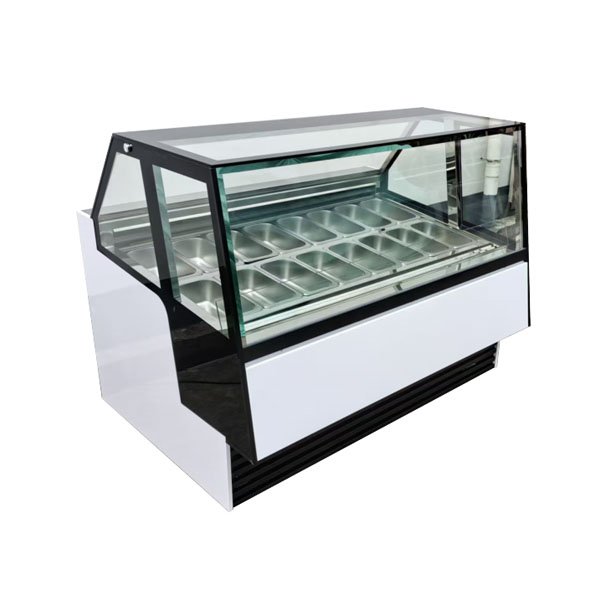
The biggest mistakes shop owners make when buying a gelato display case aren’t about the brand—they are about mismatched specs. Buying a unit that won’t fit through your front door, underestimating your daily flavor rotation, or failing to prep the right electrical circuit can delay your grand opening for weeks. Here is a no-nonsense guide to sizing and specifying your next commercial ice cream display cabinet.
1. Space & Footprint Planning: Matching Equipment to Your Floor Plan
Before looking at pan capacities, you must measure your physical space and entryways.
- The Doorway Test: Our professional display series features a uniform depth of 1150mm. This is a deep, high-capacity profile. You must measure your shop’s doorways, hallways, and tight corners. If your standard door is narrower than 1150mm, you will need double doors or plan to remove the door frame during delivery.
- Counter Alignment: All models in this series share a standardized height of 1250mm and depth of 1150mm. This uniformity makes it incredibly easy for contractors to build custom front counters or align the freezer seamlessly with your existing POS stations and pastry cases.
- Width Variations: The only dimension that changes based on capacity is the width, ranging from 1250mm (compact) to 2000mm (flagship size).
2. Capacity & Output: Choosing the Right Size for Your Daily Traffic
Don’t buy a 20-pan case if you only sell 8 flavors—half-empty cases look unappealing and waste electricity. Conversely, a 12-pan case in a high-traffic tourist spot will cause constant restocking bottlenecks. Use this baseline to match your business model:
| Model Capacity | Cabinet Width | Best Suited Business Type |
|---|---|---|
| 12 Pans | 1250mm | Add-on Sales: Cafes, bakeries, or restaurants adding a small gelato menu to their existing offerings. |
| 14 – 16 Pans | 1400mm – 1550mm | Standard Shops: Dedicated neighborhood ice cream parlors and dessert shops with a solid daily rotation. |
| 18 – 20 Pans | 1800mm – 2000mm | High-Volume: Flagship gelaterias, busy food courts, and tourist destinations requiring maximum flavor variety. |
3. Power, Cooling & Site Preparation Checklist
Commercial refrigeration requires commercial-grade site prep. Hand this checklist to your electrician before the equipment arrives:
- Voltage & Frequency: All units operate on 220V/50Hz. Ensure your shop’s electrical panel supports this, especially if you are importing the unit to a region with different standard voltages.
- Dedicated Circuits: Power consumption scales with size. The 12-pan model draws 1260W, while the 20-pan model requires 2600W. Each display case must be on its own dedicated circuit to prevent tripping during peak compressor cycles.
- Temperature Parameters: These units are calibrated to hold a strict -18°C to -22°C range, utilizing industry-standard R404A refrigerant.
- Ventilation Clearance: Never push the cabinet flush against a solid back wall without checking the compressor vents. Commercial units need breathing room to dissipate heat; otherwise, the compressor will overwork and fail.
4. Sourcing Tips for Equipment Dealers & Multi-Store Buyers
If you are an equipment distributor or a franchise owner outfitting multiple locations, standardizing your equipment profile saves money on logistics.
- Container Loading (FCL/LCL): Because the 1150mm depth and 1250mm height are uniform across the entire series, mixing different capacities (e.g., ordering five 12-pan units and two 20-pan units) is highly efficient for container packing.
- Inventory Strategy: For local stock, the 12-pan (1250mm) and 16-pan (1550mm) models are typically the fastest-moving sizes, covering 80% of standard commercial inquiries.
Ready to Spec Your Store or Stock Your Warehouse?
Stop guessing with your equipment specs. Whether you are a single shop owner upgrading your front-of-house or a dealer looking for reliable wholesale refrigeration, we have the exact size to fit your floor plan.
