
How to Choose the Right Commercial Bakery Oven for Your Business: A Complete Buyer’s Guide
Find the best commercial oven type for your bakery, restaurant, hotel, or café — and make every bake count.
Whether you run a high-volume bakery, a hotel kitchen, a busy restaurant, or a growing café, your commercial bakery oven is the heart of your production line. Choosing the wrong oven can lead to inconsistent baking results, wasted energy, slow output, and frustrated kitchen staff. Choosing the right one means better product quality, smoother workflows, and a stronger bottom line.
This guide walks you through the main types of commercial baking ovens, explains which business scenarios each one fits best, and helps you understand what to look for so you can invest with confidence. If you’re searching for a bakery oven for sale or exploring options for a commercial bread oven, you’re in the right place.
Why Does Your Commercial Oven Choice Matter So Much?
A professional bakery oven is one of the largest investments in any commercial kitchen. It directly affects:
- Product consistency — Uneven heat distribution leads to unevenly baked goods, customer complaints, and product waste.
- Production capacity — An undersized or slow oven creates bottlenecks during peak hours.
- Energy costs — Inefficient ovens drive up utility bills over time.
- Menu flexibility — Some ovens handle bread, pastries, and pizza; others are built for a narrower range.
- Kitchen space — Floor space in a commercial kitchen is valuable; your oven must fit your layout.
Understanding the strengths of each industrial baking oven type helps you avoid costly mistakes and find equipment that truly supports your daily operations.
What Are the Main Types of Commercial Bakery Ovens?
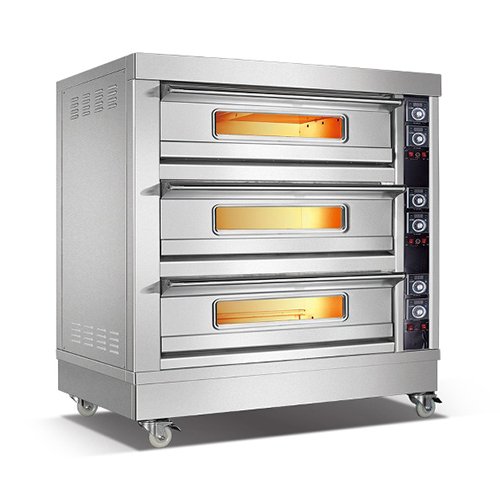
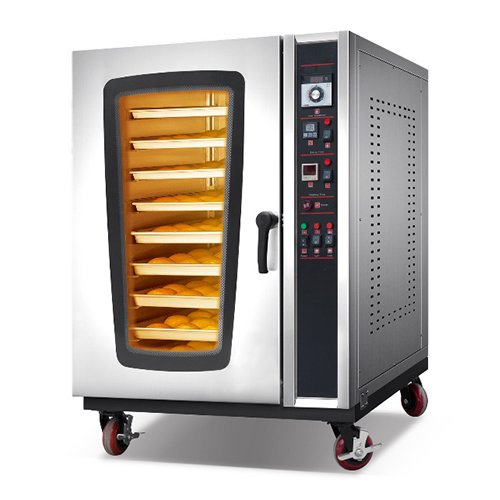
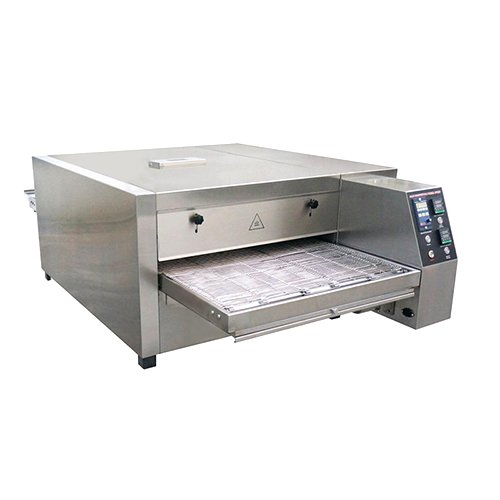
There are four primary categories of commercial baking equipment used across the foodservice and baking industry. Each type is engineered for different production needs, space constraints, and product types.

Which Commercial Oven Type Is Right for Your Business?
Use the comparison below to quickly match your business type with the most suitable commercial baking oven:
What Problems Can the Right Commercial Bakery Oven Solve?
If you’re experiencing any of the following challenges in your commercial kitchen, upgrading your bakery oven equipment may be the solution:
How to Match Your Oven to Your Business Type
🏨 Hotels & Resorts
Hotel kitchens need versatility. A combination of a commercial convection oven for breakfast pastries and a deck oven for baking bread and pizza gives your pastry team full flexibility. For large banquet operations, a rotary oven can handle high-volume roll and bread production for events.
🍕 Pizzerias & Fast-Casual Restaurants
Speed and consistency are everything. A conveyor pizza oven keeps up with rush-hour demand while requiring minimal operator attention. For restaurants that also serve artisan-style pizza, a commercial pizza oven with stone decks delivers that authentic char and crispy base your customers expect.
🥐 Bakeries & Pastry Shops
Dedicated bakeries often benefit from multiple oven types. A bakery deck oven handles artisan breads and crusty loaves, while a bakery convection oven takes care of cookies, cakes, and delicate pastries. Growing operations may add a rotary rack oven to scale production without sacrificing quality.
☕ Cafés & Coffee Shops
Space is often limited, and the menu is focused. A compact commercial convection oven is typically the best fit — it handles croissants, muffins, scones, and light lunch items efficiently. Easy to operate, quick to preheat, and small enough to fit behind the counter.
🏪 Supermarket In-Store Bakeries & Central Kitchens
When you’re baking for retail display cases or supplying multiple locations, volume and consistency are non-negotiable. A commercial rotary oven paired with a rack system streamlines production. For flatbreads and grab-and-go items, a conveyor oven adds continuous throughput.
What Key Features Should You Look for in a Commercial Bakery Oven?
Regardless of the oven type you choose, these features make a meaningful difference in daily operation:
- Precise temperature control — Digital controls allow accurate temperature setting, which is critical for consistent baking across different recipes.
- Steam injection — Essential for bread baking. Steam in the first stage of baking creates a glossy, crisp crust.
- Energy-efficient insulation — Well-insulated oven chambers retain heat better, reducing energy waste and keeping your kitchen cooler.
- Durable construction — Stainless steel interiors and exteriors withstand the demands of a busy commercial kitchen and are easy to clean.
- Programmable recipes — Store your most-used baking programs so any team member can produce consistent results.
- Easy maintenance access — Ovens with accessible components reduce downtime and service costs.
Electric vs. Gas Commercial Ovens: Which Should You Choose?
Both electric commercial ovens and gas commercial ovens are widely used in professional bakeries and commercial kitchens. Your choice depends on your facility’s infrastructure and operational priorities:
Many operators choose based on what utility connections are already available in their kitchen. Both options deliver professional-grade results when paired with quality commercial baking equipment.
Essential Tips Before You Buy a Commercial Bakery Oven
- Measure your space carefully — Account for the oven footprint, door swing, ventilation clearance, and rack maneuvering room.
- Assess your production needs honestly — Buy for your current volume plus reasonable growth, not for a theoretical maximum you may never reach.
- Check your utility infrastructure — Confirm your electrical capacity or gas supply before ordering. Retrofitting utilities adds cost and delay.
- Consider your menu — If you bake a wide variety of products, you may need more than one oven type for optimal results.
- Ask about after-sales support — Reliable spare parts availability and technical support matter as much as the oven itself.
- Request a product demonstration — Whenever possible, see the oven in action before committing to a purchase.
Ready to Find the Perfect Commercial Bakery Oven?
Whether you need a deck oven, convection oven, rotary oven, or conveyor oven — our team is here to help you choose the right solution for your kitchen.
Investing in the right commercial bakery oven is one of the most impactful decisions you can make for your food business. Take the time to evaluate your needs, compare oven types, and choose equipment that will grow with your operation. The right oven doesn’t just bake — it elevates your entire production.
